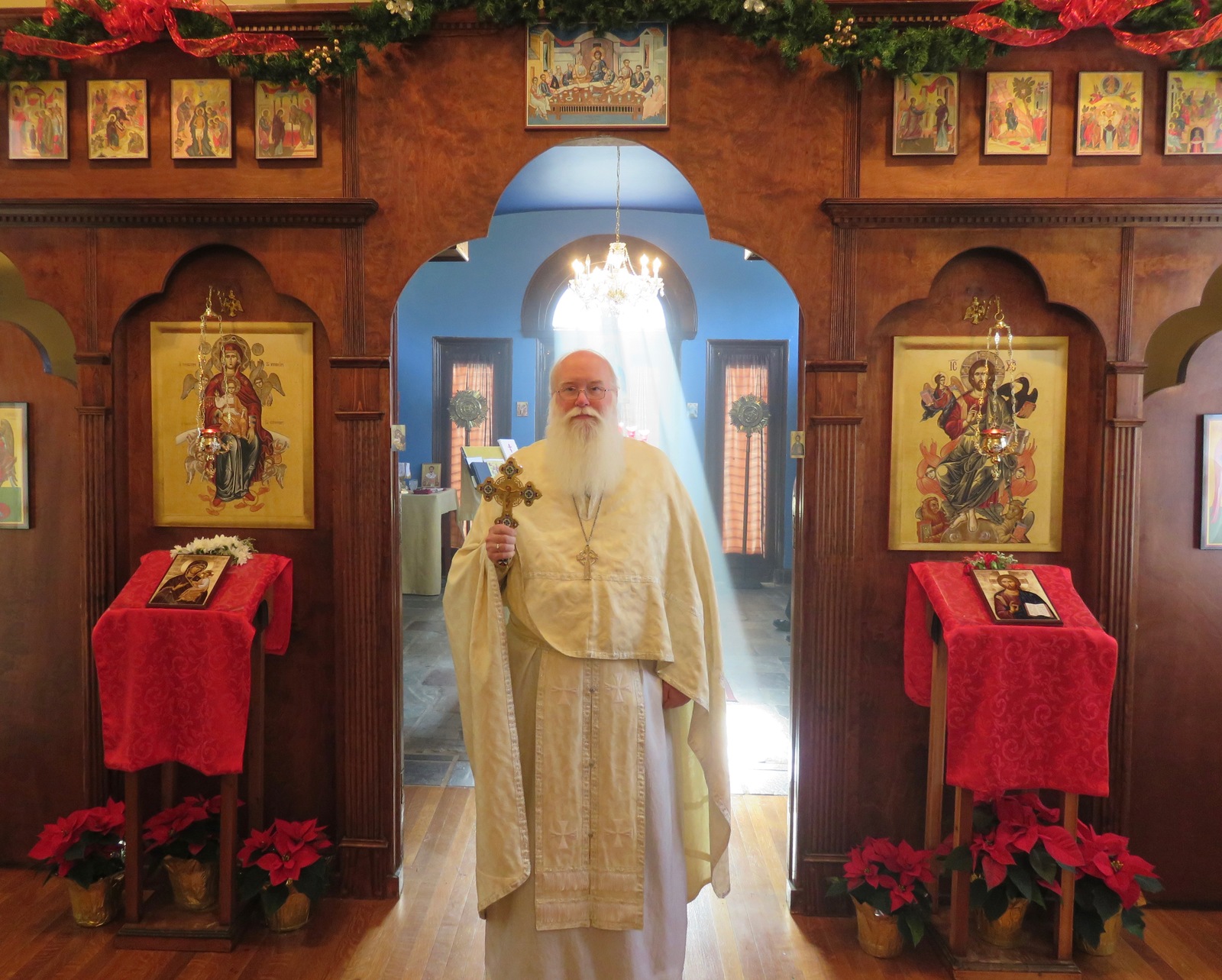
St. Luke Orthodox Church is a vibrant, spiritual home to a growing community located in Anniston, Alabama, serving all of Calhoun County and East Alabama,
Everyone is welcome to visit, pray and worship at our parish.
1415 Woodstock Avenue
Anniston, AL. 36207
Upcoming Services
Saturday, November 8th
Great Vespers 4 pm
Sunday, November 9th
St. Nektarios, Wonderworker of Aegina
Divine Liturgy 10 am
Lives of the Saints
Saints of the Day
Saint John Chrysostom, Archbishop of Constantinople
Saint John Chrysostom, Archbishop of Constantinople, one of the Three Hierarchs [January 30], was born at Antioch in about the year 347 into the family of a military commander. His father, Secundus, died soon after the birth of his son. His mother, Anthusa, widowed at twenty years of age, did not…
Read the Life
Troparion & Kontakion
Martyrs Nikephoros, Antoninus, and Germanus of Caesarea, in Palestine
Saint Nikephoros (Nikēphóros), Antoninus, and Germanus were beheaded in Caesarea of Palestine during the reign of Maximian by the ruler Firmilian.
Read the Life
Troparion & Kontakion
Martyr Manetha of Cæsarea in Palestine
Saint Manetha was captured along with Saints Antoninus, Nikēphóros and Germanus. She suffered many tortures. She was led naked through the city, was mocked, and received the crown of martyrdom when she was burned alive.
Read the Life
Troparion & Kontakion
Monastic Martyr Damascene of the Lavra
Saint Damascene was a monk from Constantinople. His parents Kyriakos and Kyriake lived in the Galatea district of the city, and they named their son Diamantes. Orphaned at a young age, and without parental guidance, the boy became rather undisciplined in his conduct. One day he was caught doing…
Read the Life
Troparion & Kontakion
Stockholm Icon of the Mother of God
The history of the Stockholm Icon of the Mother of God is closely connected with the sacred symbol of the Tikhvin Icon of the Mother of God (June 26) which appeared in Russia in 1383, on the banks of the Tikhvinka River. The appearance of the Stockholm Icon of the Most Holy Theotokos occurred…
Read the Life
Troparion & Kontakion
Weekly Bulletin
Weekly bulletin
Below is a guide to the icon on the cover of the bulletin, moving generally from upper left to lower right, describing each panel and its meaning:
Center: Saint Nektarios
Depicted as a bishop, wearing a sakkos (bishop’s vestment) and omophorion with crosses.
He holds the Gospel Book, symbolizing his role as teacher and preacher of the Word.
His right hand gives the blessing of Christ (ICXC).
The gold background signifies the light of divine grace.
The text beside him reads: “Ὁ Ἅγιος Νεκτάριος ὁ ἐν Αἰγίνῃ, Ἐπίσκοπος Πενταπόλεως” (“Saint Nektarios of Aegina, Bishop of Pentapolis”).
Scenes from His Life
Top Row (Left to Right)
Η Γέννησις τοῦ Ἁγίου – The Birth of the Saint Depicts his birth in Selymbria of Thrace (1846) to pious parents Dimos and Maria Kephalas.
Διδασκόμενος τὰ ἱερὰ γράμματα – Learning the Holy Scriptures Shows the young Nektarios studying the Scriptures under the guidance of his family and early teachers. Even as a child, he was devoted to Christ.
Εἰς τὴν Κωνσταντινούπολιν – Journey to Constantinople As a young man, he goes to Constantinople seeking work and education, enduring great poverty and hardship but relying on God.
Μετὰ τὰ ἅγια λείψανα εἰς Χῖον – To the Island of Chios He becomes a schoolteacher and later a monk on Chios, known for his humility, prayer, and service.
Second Row
Χειροτονία Εἰς Ἐπίσκοπον – Consecration as Bishop Nektarios is ordained Bishop of Pentapolis in Egypt (under the Patriarchate of Alexandria). This marks the height of his ecclesial service.
Πρός τὴν ἐξορίαν – Toward Exile After being falsely accused of ambition and intrigue, he is unjustly removed from office and sent away. His humility in persecution becomes the hallmark of his sanctity.
Προσγειαζόμενος εἰς Πειραιᾶ – Arrival in Piraeus After exile, he comes to Greece (Piraeus). He has no position or support but places his trust in God’s providence.
Third Row
Ἱεροκήρυξ εἰς Εὔβοιαν – Preaching in Euboea He serves as a preacher and confessor, touching countless hearts with his sermons and spiritual wisdom.
Θεραπεύων τοὺς δαιμονιζομένους – Healing the Afflicted Shows his gift of healing and deliverance — through prayer, he healed the sick and freed many from demonic oppression.
Φυτευόμενος τὴν Ἁγίαν Θεοτόκον Δαμασκηνὴν Κυψέλην – Founding the Holy Convent Saint Nektarios establishes the women’s monastery on Aegina dedicated to the Holy Trinity, guiding the nuns as a spiritual father.
Lower Row
Διαλέγων ταῖς Μοναχαῖς – Teaching the Nuns Depicts his daily life at Aegina: instructing the sisters, writing theological works, and living a life of prayer and meekness.
Η Κοίμησις τοῦ Ἁγίου – The Falling Asleep of the Saint Shows his repose on November 8, 1920, at Aretaeion Hospital in Athens. Miracles began immediately after his death — the hospital room filled with fragrance, and many were healed by his relics.
Ὁ Ὅσιος Ἀναγνωριζόμενος ὑπὸ τῆς Ἐκκλησίας – Glorification by the Church Illustrates his canonization in 1961 by the Ecumenical Patriarchate — recognition of his holiness and miracles.
Symbolism and Theology
The narrative border presents his life as a “visual hymn” of endurance, faith, humility, and resurrection.
His trials and vindication reflect Christ’s own path — from humiliation to glory.
The icon invites the faithful to imitate his patience in suffering, love for enemies, and trust in divine providence.